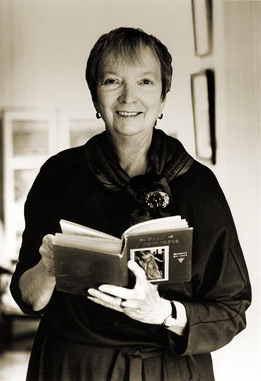
Madeleine L'Engle
poet, novelist, children's writer, writer, essayist, science fiction writer, librarian
Read on Wikipedia1918 – 2007
All Quotes by Madeleine L'Engle
“In the evening of life we shall be judged on love, and not one of us is going to come off very well, and were it not for my absolute faith in the loving forgiveness of my Lord I could not call on him to come.”
“Inspiration usually comes during work, rather than before it.”
“All will be redeemed in God's fullness of time, all, not just the small portion of the population who have been given the grace to know and accept Christ. All the strayed and stolen sheep. All the little lost ones.”
“We are all strangers in a strange land, longing for home, but not quite knowing what or where home is. We glimpse it sometimes in our dreams, or as we turn a corner, and suddenly there is a strange, sweet familiarity that vanishes almost as soon as it comes…”
“Poetry, at least the kind I write, is written out of immediate need; it is written out of pain, joy, and experience too great to be borne until it is ordered into words. And then it is written to be shared.”
“Speaking of ways, pet, by the way, there is such a thing as a tesseract.”
“Just because we don't understand doesn't mean that the explanation doesn't exist.”
“How long your closet held a whiff of you,”
“Suddenly there was a great burst of light through the Darkness. The light spread out and where it touched the Darkness the Darkness disappeared. The light spread until the patch of Dark Thing had vanished, and there was only a gentle shining, and through the shining came the stars, clear and pure.”
“As the skipping rope hit the pavement, so did the ball. As the rope curved over the head of the jumping child, the child with the ball caught the ball. Down came the ropes. Down came the balls. Over and over again. Up. Down. All in rhythm. All identical. Like the houses. Like the paths. Like the flowers”
“You're given the form, but you have to write the sonnet yourself. What you say is completely up to you.”
“Alike and Equal are not the same.”
“Hate was nothing that IT didn't have. IT knew all about hate.”
“Suddenly she knew. She knew! Love. That was what she had that IT did not have. She had Mrs. Whatsit's love, and her father's, and mother's, and the real Charles Wallace's love, and the twins', and Aunt Beast's. And she had her love for them. But how could she use it? What was she meant to do?”
“A book, too, can be a star, “explosive material, capable of stirring up fresh life endlessly,” a living fire to lighten the darkness, leading out into the expanding universe.”
“When we are self-conscious, we cannot be wholly aware; we must throw ourselves out first. This throwing ourselves away is the act of creativity. So, when we wholly concentrate, like a child in play, or an artist at work, then we share in the act of creating. We not only escape time, we escape our self-conscious selves.”
“The medieval mystics say the true image and the true real met once and for all on the cross: once and for all: and yet they still meet daily.”
“Here we are living in a world of "identity crises," and most of us have no idea what an identity is. Half the problem is that an identity is something which must be understood intuitively, rather than in terms of provable fact. An infinite question is often destroyed by finite answers. To define everything is to annihilate much that gives us laughter and joy.”
“We do have to use our minds as far as they will take us, yet acknowledging that they cannot take us all the way. We can give a child a self-image. But is this a good idea? Hitler did a devastating job at that kind of thing. So does Chairman Mao. … I haven't defined a self, nor do I want to. A self is not something static, tied up in a pretty parcel and handed to the child, finished and complete. A self is always becoming.”
“I think that all artists, regardless of degree of talent, are a painful, paradoxical combination of certainty and uncertainty, of arrogance and humility, constantly in need of reassurance, and yet with a stubborn streak of faith in their own validity no matter what.”
“The rational intellect doesn't have a great deal to do with love, and it doesn't have a great deal to do with art. I am often, in my writing, great leaps ahead of where I am in my thinking, and my thinking has to work its way slowly up to what the "superconscious" has already shown me in a story or poem.”
“It is all, as usual, paradox. I have to use what intellect I have in order to write books, but I write the kind of books I do in order that I may try to set down glimpses of things that are on the other side of the intellect. We do not go around and discard the intellect, but we must go through and beyond it.”
“How do we teach a child — our own, or those in a classroom — to have compassion: to allow people to be different; to understand that like is not equal; to experiment; to laugh; to love; to accept the fact that the most important questions a human being can ask do not have — or need — answers.”
“Love can't be pinned down by a definition, and it certainly can't be proved, anymore than anything else important in life can be proved.”
“When a child who has been conceived in love is born to a man and a woman, the joy of that birth sings throughout the universe. The joy of writing or painting is much the same, and the insemination comes not from the artist himself but from his relationship with those he loves, with the whole world. All real art is, in its true sense, religious; it is a religious impulse; there is not such thing as a non-religious subject.”
“Detachment and involvement: the artist must have both. The link between them is compassion. It has taken me over fifty years to get a glimmer of what this means.”
“We do live, all of us, on many different levels, and for most artists the world of imagination is more real than the world of the kitchen sink.”
“It isn't always the middle-aged who refuse to listen, who will not even try to understand another point of view. One boy would not get it through his head that for all adults God is not an old man in a white beard sitting on a cloud. As far as this boy was concerned, this old gentleman was the adult's god, and therefore he did not believe in God.”
“Nothing important is completely explicable.”
“The uncommon man has done the impossible and there has been that much more light in the world because of it. Children respond to heroes by thinking creatively and sometimes in breaking beyond the bounds of the impossible in their turn, and so becoming heroes themselves.”
“A great piece of literature does not try to coerce you to believe it or agree with it. A great piece of literature simply is. It is a vehicle of truth, but it is not a blueprint, and we tend to confuse the two.”
“What can we give a child when there is nothing left? All we have, I think, is the truth, the truth that will set him free, not limited, provable truth, but the open, growing, evolving truth that is not afraid.”
“I wish that we worried more about asking the right questions instead of being so hung up on finding answers. I don't need to know the difference between a children's book and an adult one; it's the questions that have come from thinking about it that are important. I wish we'd stop finding answers for everything. One of the reasons my generation has mucked up the world to such an extent is our loss of the sense of the mysterious.”
“All forms of art are consciousness expanders, and I am convinced that they will take us further, and more consciously, than drugs.”
“Gregory of Nyssa points out that Moses's vision of God began with the light, with the visible burning bush, the bush which was bright with fire and was not consumed; but afterwards, God spoke to him in a cloud. After the glory which could be seen with human eyes, he began to see the glory which is beyond and after light. The shadows are deepening all around us. Now is the time when we must begin to see our world and ourselves in a different way.”
“My protagonists, male and female, are me. And so I must be able to recall exactly what it was like to be five years old, and twelve, and sixteen, and twenty-two, and. . . . For, after all, I am not an isolated fifty-seven years old; I am every other age I have been, one, two, three, four, five, six, seven . . . all the way up to and occasionally beyond my present chronology.”
“We rebel against the impossible. I sense a wish in some professional religion-mongers to make God possible, to make him comprehensible to the naked intellect, domesticate him so that he's easy to believe in. Every century the Church makes a fresh attempt to make Christianity acceptable. But an acceptable Christianity is not Christian; a comprehensible God is no more than an idol.”
“If we commit ourselves to one person for life this is not, as many people think, a rejection of freedom; rather, it demands the courage to move into all the risks of freedom, and the risk of love which is permanent; into that love which is not possession but participation.”
“When a promise is broken, the promise still remains. In one way or another, we are all unfaithful to each other, and physical unfaithfulness is not the worst kind there is.”
“If our love for each other really is participatory, then all other human relationships nourish it; it is inclusive, never exclusive. If a friendship makes me love Hugh more, then I can trust that friendship. If it thrusts itself between us, then it should be cut out, and quickly.”
“I cannot believe that God wants punishment to go on interminably any more than does a loving parent. The entire purpose of loving punishment is to teach, and it lasts only as long as is needed for the lesson. And the lesson is always love.”
“If our usual response to an annoying situation is a curse, we're likely to meet emergencies with a curse. In the little events of daily living we have the opportunity to condition our reflexes, which are built up out of ordinary things. And we learn to bless first of all by being blessed. My reflexes of blessing have been conditioned by my parents, my husband, my children, my friends”
“One of our children when he was two or three years old used to rush at me when he had been naughty, and beat against me, and what he wanted by this monstrous behavior was an affirmation of love. And I would put my arms around him and hold him very tight until the dragon was gone and the loving small boy had returned.”
“One reason nearly half my books are for children is the glorious fact that the minds of children are still open to the living word; in the child, nightside and sunside are not yet separated; fantasy contains truths which cannot be stated in terms of proof.”
“It has often struck me with awe that some of the most deeply religious people I know have been, on the surface, atheists.”
“When we were children, we used to think that when we were grown-up we would no longer be vulnerable. But to grow up is to accept vulnerability... To be alive is to be vulnerable.”
“Maybe you have to know darkness before you can appreciate the light.”
“The truth of a story is what the novelist strives for, and quite often the writer is taken down strange and unexpected paths on this search.”
“Faith is for the part of the story that superficially isn’t believable.”
“We are not to retreat from life, pinning our hopes on ‘elsewhere.’ but to know that we will come to that final destination best by living full here and now, be it through joy, or pain, or a mix of both.”
“Life is full of questions, and we are free to ask them, to understand, occasionally, that we are not going to get an answer, or at least not the answer we expect, and then we are called to move on. But I believe that God encourages us to ask questions.”
“Truth is what is true, and it's not necessarily factual. Truth and fact are not the same thing. Truth does not contradict or deny facts, but it goes through and beyond facts. This is something that it is very difficult for some people to understand. Truth can be dangerous.”
“Language is often changed by writers. We speak English today because Chaucer chose to write in the language of the common people, rather than the Latin or French used by those who were educated. James Joyce had an almost equally profound effect on language when he wrote about the inner self, rather than the outer self.”
“I wrote because I wanted to know what everything was about. My father, before I was born, had been gassed in the first World War, and I wanted to know why there were wars, why people hurt each other, why we couldn't get along together, and what made people tick. That's why I started to write stories.”
“There's more to life than just the things that can be explained by encyclopedias and facts. Facts alone are not adequate.”
“I really enjoy good murder mystery writers, usually women, frequently English, because they have a sense of what the human soul is about and why people do dark and terrible things. I also read quite a lot in the area of particle physics and quantum mechanics, because this is theology. This is about the nature of being. This is what life is all about. I try to read as widely as I possibly can.”
“Kids don't hesitate to ask questions. And it's a great honor to have the kids say, "Your books have made me trust you."”
“I sometimes think God is a s--t — and he wouldn't be worth it otherwise. He's much more interesting when he's a s--t.”
“It takes a lot of intellect to have faith, which is why so many people only have religiosity.... I'm against people taking the Bible absolutely literally, rather than letting some of it be real fantasy, like Jonah... Faith is best expressed in story.”
“Henneberger: If the Bible is not literally true, does that mean we don’t need to take it seriously? L'Engle: Oh no, you do, because it’s truth, not fact, and you have to take truth seriously even when it expands beyond the facts.”
“The great thing about getting older is that you don't lose all the other ages you've been.”
“Death is contagious; it is contracted the moment we are conceived.”
“Truth is what is true, and it's not necessarily factual. Truth and fact are not the same thing. Truth does not contradict or deny facts, but it goes through and beyond facts. This is something that it is very difficult for some people to understand. Truth can be dangerous.”
“In the evening of life we shall be judged on love, and not one of us is going to come off very well, and were it not for my absolute faith in the loving forgiveness of my Lord I could not call on him to come.”
“Conversion for me was not a Damascus Road experience. I slowly moved into an intellectual acceptance of what my intuition had always known.”
“We cannot always cry at the right time”
“But there is something about Time. The sun rises and sets. The stars swing slowly across the sky and fade. Clouds fill with rain and snow, empty themselves, and fill again. The moon is born, and dies, and is reborn. Around millions of clocks swing hour hands, and minute hands, and second hands. Around goes the continual circle of the notes of the scale. Around goes the circle of night and day, the circle of weeks forever revolving, and of months, and of years.”
“The great thing about getting older is that you don't lose all the other ages you've been.”
“But my memories are like a fire in winter—whenever I'm cold I can warm my hands at them.”
“I like the fact that in ancient Chinese art the great painters always included a deliberate flaw in their work: human creation is never perfect.”