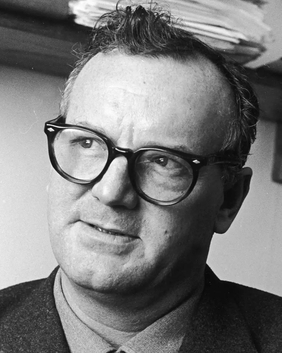
All Quotes by C. Wright Mills
“Neither the life of an individual nor the history of a society can be understood without understanding both.”
“Power is not of a man. Wealth does not center in the person of the wealthy. Celebrity is not inherent in any personality. To be celebrated, to be wealthy, to have power requires access to major institutions.”
“Not wishing to be disturbed over moral issues of the political economy, Americans cling to the notion that the government is a sort of automatic machine, regulated by the balancing of competing interests.”
“To have peace and not war, the drift toward a war economy, as facilitated by the moves and the demands of the sophisticated conservatives, must be stopped; to have peace without slump, the tactics and policies of the practical right must be overcome. The political and economic power of both must be broken. The power of these giants of main drift is both economically and politically anchored; both unions and an independent labor party are needed to struggle effective.”
“If we accept the Greek's definition of the idiot as an altogether private man, then we must conclude that many American citizens are now idiots. And I should not be surprised, although I don't know, if there were some such idiots even in Germany.”
“In a society of employees dominated by the marketing mentality, it is inevitable that a personality market should arise. For in the great shift from manual skills to the art of 'handling', selling and servicing people, personal or even intimate traits of employees are drawn into the sphere of exchange and become commodities in the labor market.”
“The truth about the nature and the power of the elite is not some secret which men of affairs know but will not tell. ... No matter how great their actual power, they tend to be less acutely aware of it than of the resistance of others to its use.”
“Most American men of affairs have learned well the rhetoric of public relations, in some cases even to the point of using it when they are alone, and thus coming to believe it.”
“People with advantages are loath to believe that they just happen to be people with advantages. They come readily to define themselves as inherently worthy of what they possess; they come to believe themselves 'naturally' elite, and, in fact, to imagine their possessions and their privileges as natural extensions of their own elite selves.”
“The idea of the elite as composed of men and women having a finer moral character is an ideology of the elite.”
“America is a nation with no truly national city, no Paris, no Rome, no London, no city which is at once the social center, the political capital, and the financial hub.”
“Hegel is correct: we learn from history that we cannot learn from it.”
“It is not characteristic of American executives to read books, except books on 'management' and mysteries. ... Those who who do venture into this arena ... are looked upon by their colleagues with mingled awe and incredulity.”
“The market is sovereign and in the magic economy of the small entrepreneur there is no authoritarian center… in the political sphere… the equilibrium of powers prevails, and hence there is no chance of despotism.”
“The American elite does not have any real image of peace — other than as an uneasy interlude existing precariously by virtue of the balance of mutual fright. The only seriously accepted plan for peace is the full loaded pistol. In short, war or a high state of war-preparedness is felt to be the normal and seemingly permanent condition of the United States.”
“What the main drift of the twentieth century has revealed is that the economy has become concentrated and incorporated in the great hierarchies, the military has become enlarged and decisive to the shape of the entire economic structure; and moreover the economic and the military have become structurally and deeply interrelated, as the economy has become a seemingly permanent war economy; and military men and policies have increasingly penetrated the corporate economy.”
“The top of modern American society is increasingly unified and often seems wilfully co-ordinated: at the top there has emerged an elite of power.The middle levels are a drifting set of stalemated balancing forces: the middle does not link the bottom with the top.The bottom of this society is fragmented,and even as a passive fact,increasingly powerless:at the bottom there is emerging a mass society.”
“Without an industrial economy, the modern army, as in America, could not exist; it is an army of machines. Professional economists usually consider military institutions as parasitic upon the means of production. Now, however, such institutions have come to shape much of the economic life of the United States.”
“Religion, virtually without fail, provides the army at war with its blessings, and recruits from among its officials the chaplain, who in military costume counsels and consoles and stiffens the morale of men at war.”
“The family provides the army and navy with the best men and boys that it possesses. And, as we have seen, education and science too are becoming means to the ends sought by the military.”
“One great lesson that we can learn from its systematic absence in the work of the grand theorists is that every self-conscious thinker must at all times be aware of — and hence be able to control — the levels of abstraction on which he is working. The capacity to shuttle between levels of abstraction, with ease and with clarity, is a signal mark of the imaginative and systematic thinker.”
“Any contemporary political re-statement of liberal and socialist goals must include as central the idea of a society in which all men would become men of substantive reason, whose independent reasoning would have structural consequences for their societies, its history and thus for their own life fates.”
“Above all, do not give up your moral and political autonomy by accepting in somebody else's terms the illiberal practicality of the bureaucratic ethos or the liberal practicality of the moral scatter. Know that many personal troubles cannot be solved merely as troubles, but must be understood in terms of public issues — and in terms of the problems of history making.”
“The ideals of liberalism have been divorced from any realities of modern social structure that might serve as the means of their realization. ... The detachment of liberalism from the facts of a going society make it an excellent mask for those who do not, cannot, or will not do what would have to be done to realize its ideals.”
“If you do not specify and confront real issues, what you say will surely obscure them. If you do not embody controversy, what you say will be an acceptance of the drift to the coming human hell.”
“IBM Plus Reality Plus HumanismSociology”
“We know well that all new cultural beginnings today must be part of world culture; that no truly intellectual life can occur if the mind is restricted; that no art can have genuine and everlasting value if it is not in a universal language. East and West. God knows there is enough restriction. Enough laziness of stereotypes. Smash them, we say to ourselves. And the only way to do that is to open up a true world forum that is absolutely free.”
“For the corporation executives, the military metaphysic often coincides with their interest in a stable and planned flow of profit; it enables them to have their risk underwritten by public money; it enables them reasonably to expect that they can exploit for private profit now and later, the risky research developments paid for by public money. It is, in brief, a mask of the subsidized capitalism from which they extract profit and upon which their power is based.”
“An expensive arms race, under cover of the military metaphysic, and in a paranoid atmosphere of fright, is an economically attractive business. To many utopian capitalists, it has become the Business Way of American Life."”
“Some men want war for sordid, others for idealistic, reasons; some for personal gain, others for impersonal principle. But most of those who consciously want war and accept it, and so help to create its "inevitability," want it in order to shift the locus of their problems.”